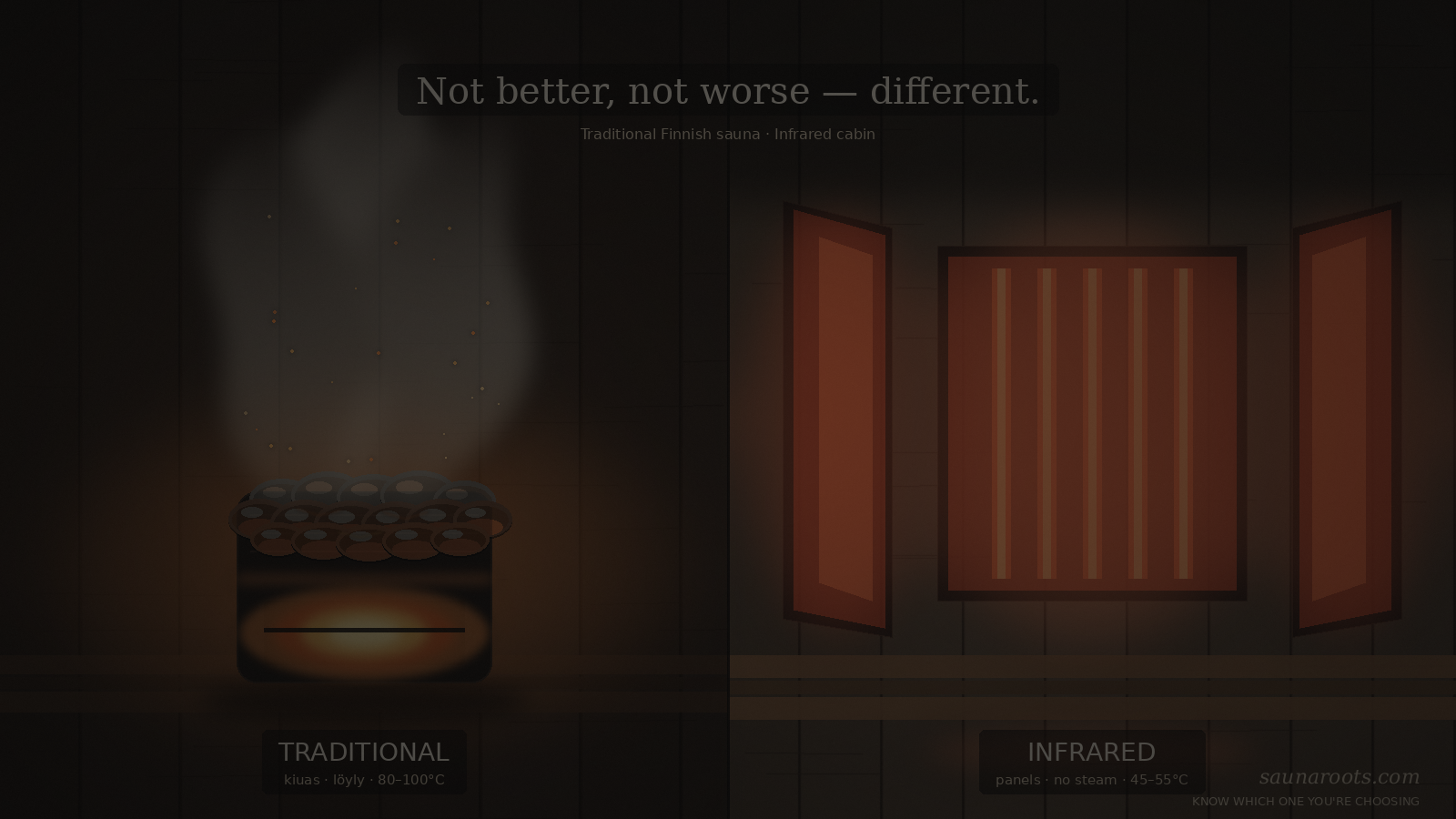
Let me say this upfront: I don’t think infrared is a fraud. People who use infrared cabins and enjoy them are not being tricked. The heat is real, the sweat is real, and there’s legitimate research suggesting real benefits — improved circulation, muscle recovery, stress reduction.
But infrared and traditional Finnish sauna are different things. Not better and worse — different. And if you’re trying to find authentic löyly in New York, knowing the difference matters a lot.
How they actually work
A traditional sauna heats the air. You sit in a room at 80–100°C. The hot air heats your skin, you sweat, your core temperature rises. The critical element is the keris — the stone-topped stove. When you pour water on those stones, you get löyly: a burst of steam that raises humidity and makes the heat feel alive, present, almost physical. This is what Finnish sauna has been built around for over 2,000 years. The steam, the ritual, the alternation between heat and cold.
An infrared cabin works differently. It uses light panels to heat your skin directly, without heating the air around you. The room might be 45–55°C — much lower than a traditional sauna. Your body absorbs the radiation and heats from the outside in. There are no stones, no steam, no löyly. The experience is gentler, quieter, and significantly more comfortable for people who find intense heat difficult.
Both make you sweat. Both raise your body temperature. The physiological pathways are just different.
Where each one wins
Infrared tends to be easier to access — smaller footprint, lower temperature, no ventilation requirements for steam. Many people find it more tolerable for longer sessions. If you’re recovering from intense exercise or looking for something meditative and low-intensity, an infrared cabin can genuinely deliver that.
Traditional sauna — especially wood-fired, with a proper keris and real löyly — is a more intense, more communal, more culturally rooted experience. The heat is harder. The contrast with cold is sharper. The ritual has more moving parts. And when it’s done right, it’s unlike anything else.
I grew up with the traditional version. That’s the one I keep coming back to, keep writing about, keep looking for in New York. Not because infrared is wrong — but because the thing I’m chasing is specifically löyly, specifically the way a proper steam hits your lungs, specifically the silence between rounds with people you trust.
That’s a personal preference, not a verdict.
The practical question for NYC
If you’re searching for “sauna” in New York and you want the traditional Finnish experience, check before you book: is there a keris with stones? Can you add water? If the answer is no, you’re looking at a dry room or infrared — which might still be worth your time, but it’s a different trip.
Neither is a bad choice. Just know which one you’re choosing.
Curious what other people think about this — especially anyone who’s used both regularly. The comments are open, or send a note directly.